
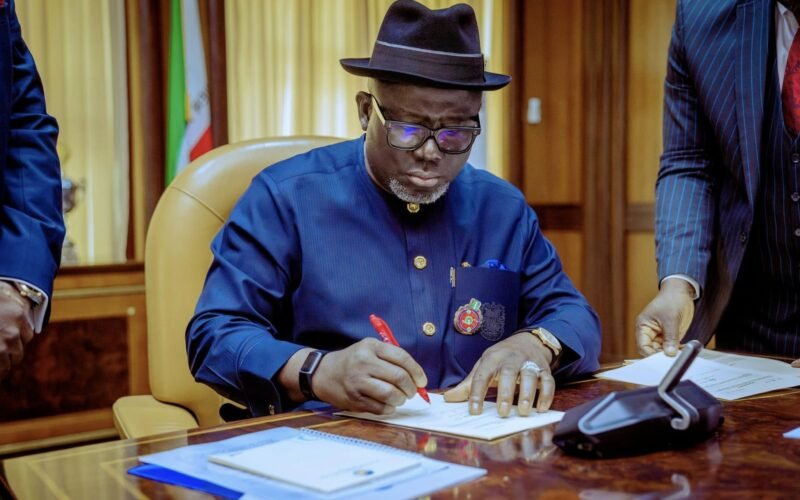
Politics is often a theatre of predictions, assumptions, and premature judgments. Rarely does any leader assume office without being confronted by skeptics who question both capacity and vision. Such was the political atmosphere that greeted the emergence of Governor Sheriff Oborevwori as Governor of Delta State. There were those who doubted his preparedness, those who dismissed his political pedigree, and those who predicted that his administration would merely coast on the achievements of previous governments without charting a distinct course. Today, those early predictions have steadily collided with reality.
Rather than becoming overwhelmed by the burden of expectations, Governor Oborevwori quietly but steadily demonstrated that leadership is ultimately measured not by loud rhetoric but by measurable impact. In no time his administration evolved into one driven by practical governance, infrastructural expansion, economic inclusion, and social investment. The “MORE Agenda,” initially dismissed in some quarters as another political slogan, has increasingly become a governance philosophy evident across the numerous sectors of Delta State.
History teaches that transformational leaders are seldom recognized immediately. Their legacies are often built brick by brick, policy by policy, and project by project until the evidence becomes too overwhelming to ignore. In Delta State, Governor Sheriff Oborevwori is writing precisely that kind of story.
One of the strongest indicators of serious governance remains infrastructure. Roads are not simply strips of asphalt; they are economic arteries through which commerce, healthcare, education, and social interaction flow. Under Governor Oborevwori, Delta State has witnessed an aggressive continuation and expansion of road construction, rehabilitation, and urban renewal projects that are reconnecting communities long isolated by poor infrastructure.
Across the Three Senatorial Districts, construction activities have become increasingly visible. Communities that previously battled impassable roads now witness improved accessibility. Beyond easing transportation, these projects stimulate local economies by attracting businesses, increasing property values, and reducing transportation costs for farmers and traders. Infrastructure, when strategically deployed, becomes an instrument of economic liberation, and this understanding appears central to the administration’s development philosophy.
Healthcare has similarly received renewed attention. Quality healthcare remains one of the most important indicators of responsive governance because it directly affects the quality of human life. Investments in hospitals, primary healthcare centres, medical equipment, and personnel reflect a government conscious that development begins with healthy citizens. Improved healthcare delivery particularly benefits rural communities where access to medical services has historically been limited, and this commitment is one of the beacons of the Oborevwori Legacy.
Education remains another defining pillar of sustainable development. A State that neglects its educational system mortgages its future. Governor Oborevwori’s administration is huge on education, as the government continues to invest massively in school infrastructure, educational facilities, and policies aimed at creating better learning environments for Delta’s children. While challenges remain, the Oborevwori trajectory defines a government committed to strengthening the foundations upon which future generations must grow. To Governor Sheriff Oborevwori, Delta State Children MUST Go To School, and the Schools MUST be good enough to impact Students Positively.
Need I mention the boisterous Support System for Students in Tertiary Institutions, Delta State has about the most liberal academic support mechanism in Nigeria, under Governor Sheriff Oborevwori, Students Bursary, Scholarship Schemes, Empowerment and Skill Acquisition Projects, as well as Students Loan are met with unparalleled commitment and dispatch. And the many State owned Institutions enjoy the timely support of government in the areas of Funding, Staff Welfare and Infrastructure.
Economic empowerment forms another significant dimension of the Oborevwori legacy. Governance in the twenty-first century demands more than constructing physical infrastructure. It requires creating opportunities for citizens to participate meaningfully in economic growth. Various empowerment programmes targeting youths, women, entrepreneurs, artisans, and small businesses have been initiated and funded to stimulate enterprise while reducing unemployment.
The importance of these initiatives extends beyond immediate financial assistance. They represent investments in human capacity, encouraging innovation, entrepreneurship, and self-reliance. Every successful small business created today becomes tomorrow’s employer, taxpayer, and contributor to economic stability.
Youth development deserves special mention because no society can achieve lasting prosperity while neglecting its youthful population. Delta State possesses one of Nigeria’s most vibrant youth demographics. Recognizing this reality, the administration has increasingly focused on skills acquisition, vocational training, entrepreneurship support, and youth engagement initiatives designed to prepare young people for a rapidly changing economy.
Rather than viewing young people merely as political supporters, the government increasingly recognizes them as strategic partners in development. This shift in governance philosophy carries profound implications for the State’s long-term economic competitiveness.
Women have equally benefited from programmes promoting inclusion, empowerment, and economic participation. Around the world, evidence consistently demonstrates that societies prosper when women receive greater opportunities to contribute economically and socially. Policies supporting female entrepreneurship, social welfare, and inclusive governance strengthen not merely households but entire communities.
Perhaps one of Governor Oborevwori’s greatest political strengths lies in his relatively calm leadership style. In an era where political drama often overshadows governance, he has largely chosen performance over publicity. This understated approach has enabled the administration to concentrate on project execution rather than political theatrics.
Leadership should never be mistaken for constant media appearances. Sometimes the most effective leaders are those whose accomplishments speak louder than their speeches. In Delta State, visible projects increasingly constitute the Governor’s strongest political communication.
Critics naturally remain an essential component of every democracy. Opposition strengthens governance by demanding accountability and encouraging better performance. However, criticism becomes far less persuasive when objective evidence increasingly contradicts negative narratives, and such is the case with Delta State, in Delta State the Street cliche… ‘Governor Sheriff Dey Work, We Dey See Am’ is the unequivocal confirmation of the leadership trust of Governor Sheriff Oborevwori.
The greatest challenge confronting many naysayers today is that completed projects are difficult to dismiss. Roads can be driven upon. Schools can be visited. Hospitals can be inspected. Empowerment programmes produce measurable beneficiaries. Development eventually becomes visible irrespective of political affiliation.
Importantly, Governor Oborevwori has largely maintained continuity while introducing his own administrative identity. Successful governance does not always require dismantling previous achievements in pursuit of artificial originality. Instead, mature leadership builds upon existing foundations while introducing fresh priorities and innovations. This balance between continuity and innovation contributes significantly to institutional stability.
Peace and security equally remain indispensable to sustainable development. Investors seek stable environments. Businesses thrive where communities remain peaceful. Citizens pursue productive lives when safety is reasonably assured. Although security challenges remain a national concern, collaboration between the Delta State Government and Security Agencies has contributed to preserving relative stability across the State.
The generous contributions to the Delta State Security Trust Fund is a bold testament to the fact that Governor Sheriff Oborevwori can be trusted not only with Power BUT with Resources, and importantly funds have been deployed from the fund to support Security Agencies in the State, and ensure real and premium time response to security issues in and around the State. To the Sheriff who is Governor, the protection of lives and property is summum bonum.
Fiscal discipline and responsible resource management also deserve recognition. Citizens increasingly demand not only visible projects but assurance that public resources are deployed efficiently. Transparent budgeting, prudent expenditure, and prioritization of developmental projects strengthen public confidence while expanding the government’s capacity to deliver additional services.
Further to the fiscal discipline and responsible management of resources of the Delta State Government under Governor Sheriff Oborevwori, it is on record that the Government has not borrowed a dime from any financial institution at home or abroad. To Governor Sheriff profligacy and wastage is anathema.
The agricultural sector presents another important frontier receiving increasing attention. Food security, rural employment, and economic diversification remain impossible without sustained agricultural investment. By supporting farmers, improving rural infrastructure, and encouraging agribusiness, Delta State positions itself to reduce dependence on oil revenues while creating alternative sources of economic prosperity.
Environmental sustainability likewise cannot be ignored in an oil-producing state like Delta. Balancing industrial development with environmental protection remains one of the defining governance challenges of the twenty-first century. Policies promoting environmental remediation, flood management, sanitation, and ecological sustainability continue to shape the State’s developmental future under The Legacy Governor.
No administration is without challenges. Governance remains a continuous journey rather than a final destination. To Governor Sheriff there are still communities requiring improved infrastructure. To Governor Sheriff there are unemployment concerns demanding innovative solutions. Healthcare and education require sustained investment. Urbanization presents emerging pressures on housing, transportation, and public services. These are the realities that Governor Sheriff Oborevwori admits and confronts daily as he blazes the trail in service delivery to the State. Governor Sheriff insists that the reward for good work is more work. To him the existing achievements of his government is a call to do MORE, and his unalterable task is to continue to dumbfound and confound naysayers with Legacy Projects.
What ultimately distinguishes successful governments is not the absence of challenges but the consistency with which they confront them. By this standard, Governor Sheriff Oborevwori’s administration continues to demonstrate a willingness to engage difficult issues while maintaining developmental momentum.
Politics often rewards perception, but history rewards performance. Years from now, political slogans will fade, campaign speeches will be forgotten, and partisan arguments will lose relevance. What will remain are roads that continue serving communities, hospitals treating patients, schools educating children, businesses employing citizens, and policies that improve lives, such is the basic philosophy that propels the government of Delta State under Governor Sheriff Oborevwori.
The emerging legacy of Governor Sheriff Oborevwori rests upon this halcyon principle…Rather than governing to satisfy daily headlines, the administration is focused on building tangible foundations for enduring development. This approach does not always generate dramatic political excitement, but it possesses the far greater advantage of producing lasting results. And the results are evident in today’s Delta State under Governor Sheriff Oborevwori.
Ultimately, the transformation unfolding across Delta State serves as a reminder that leadership should never be prematurely judged by political narratives alone. Genuine assessment belongs to evidence, outcomes, and the lived experiences of citizens.
For many who initially questioned Sheriff Oborevwori’s capacity to govern, the unfolding story of Delta State increasingly challenges those early assumptions. The Governor’s legacy is being defined not by the skepticism that greeted his emergence but by the developmental footprints his administration continues to leave across the State.
In the final analysis, the true answer to the naysayers is not found in political rebuttals or media campaigns. It is found in visible development, improving public services, expanding opportunities, and a growing confidence among citizens that government can indeed make a positive difference. And Governor Sheriff Oborevwori MUST sustain the current trajectory. If he does, there is certainly NO VACANCY in the Delta State Government House until 2031 because naturally the People will Vote a Leader they TRUST.
I must therefore urge and nudge Governor Sheriff Oborevwori to continue with PERFORMANCE over POLITICS, PERFORMANCE over PROPAGANDA, PERFORMANCE over PARTISANSHIP, and SERVICE over SYCOPHANCY, such predilection and no other shall GUARANTEE Your Quest for a Second Term come 2027, and when that is done, you may well be remembered as the leader who transformed Delta State beyond the imagination of your critics, proving beyond equivocation that performance remains the most powerful response to doubt. GO ON Sheriff.
Chris Mustapha Nwaokobia Jnr.
A Good Governance Advocacte. Leadership Trainer. And Publicist.